How to play
Slipmax, by Jonathan Leistiko
End the game with more money than anyone else. 2 to 6 players; everyone starts with 10¢.
Your turn
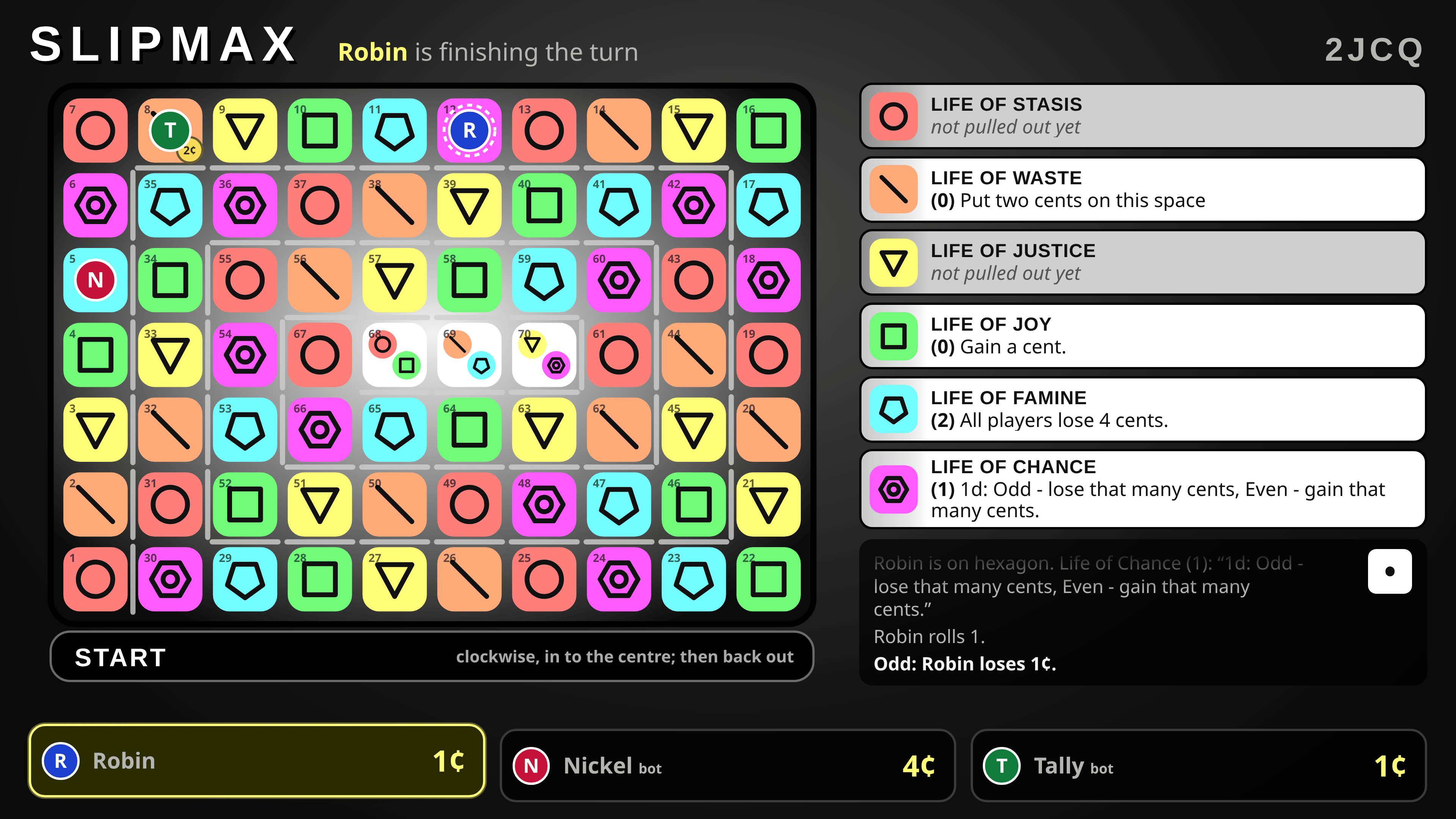
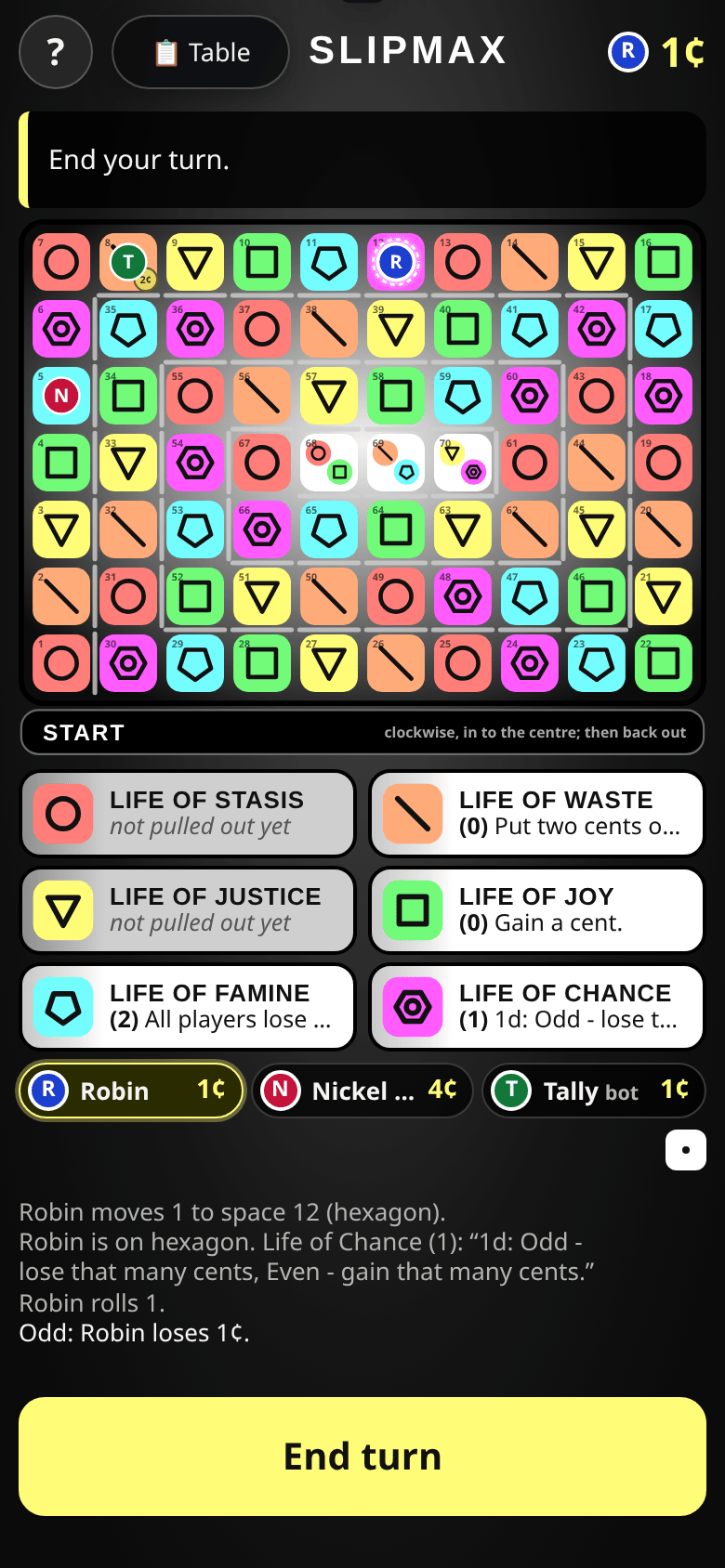
- Roll the die and move that many spaces. The board is a spiral of 70 spaces from START to the centre.
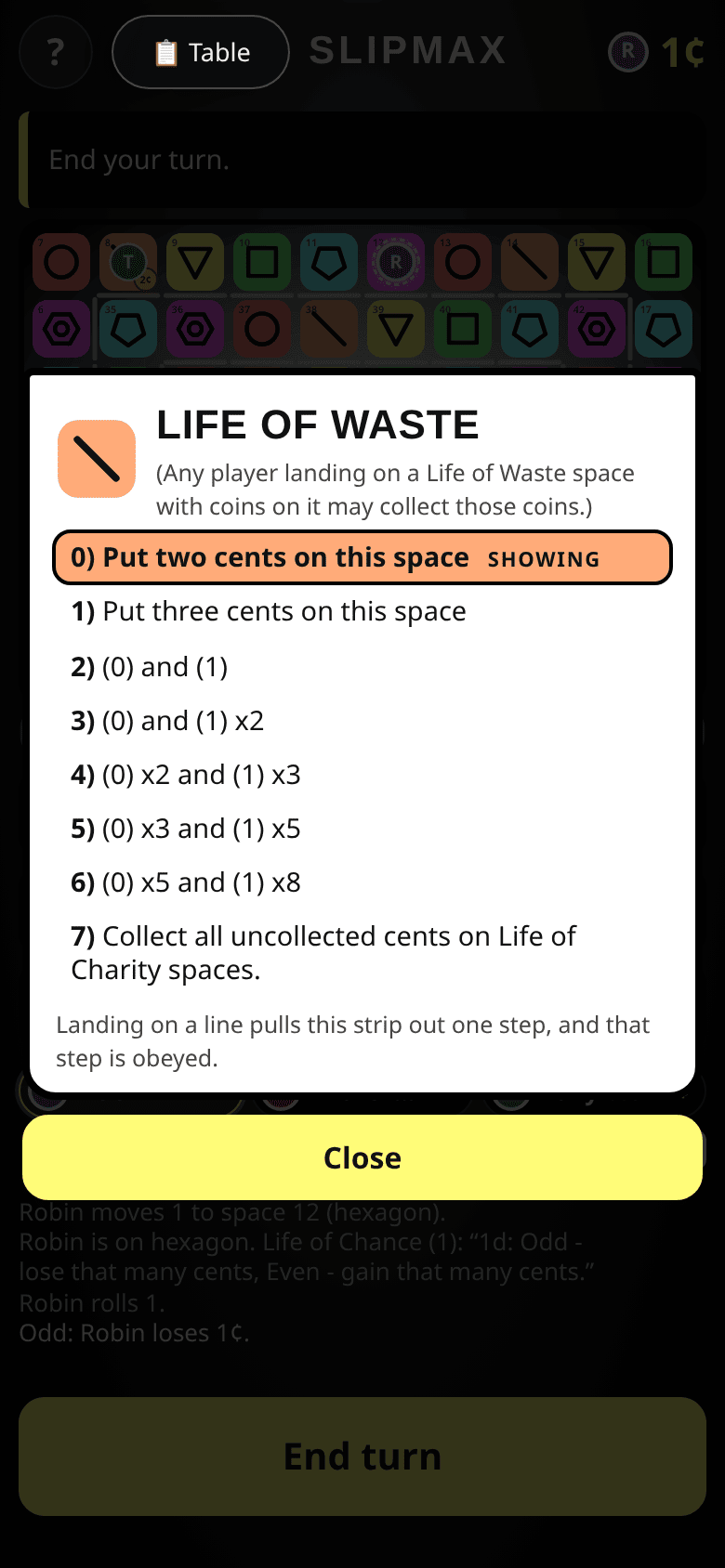
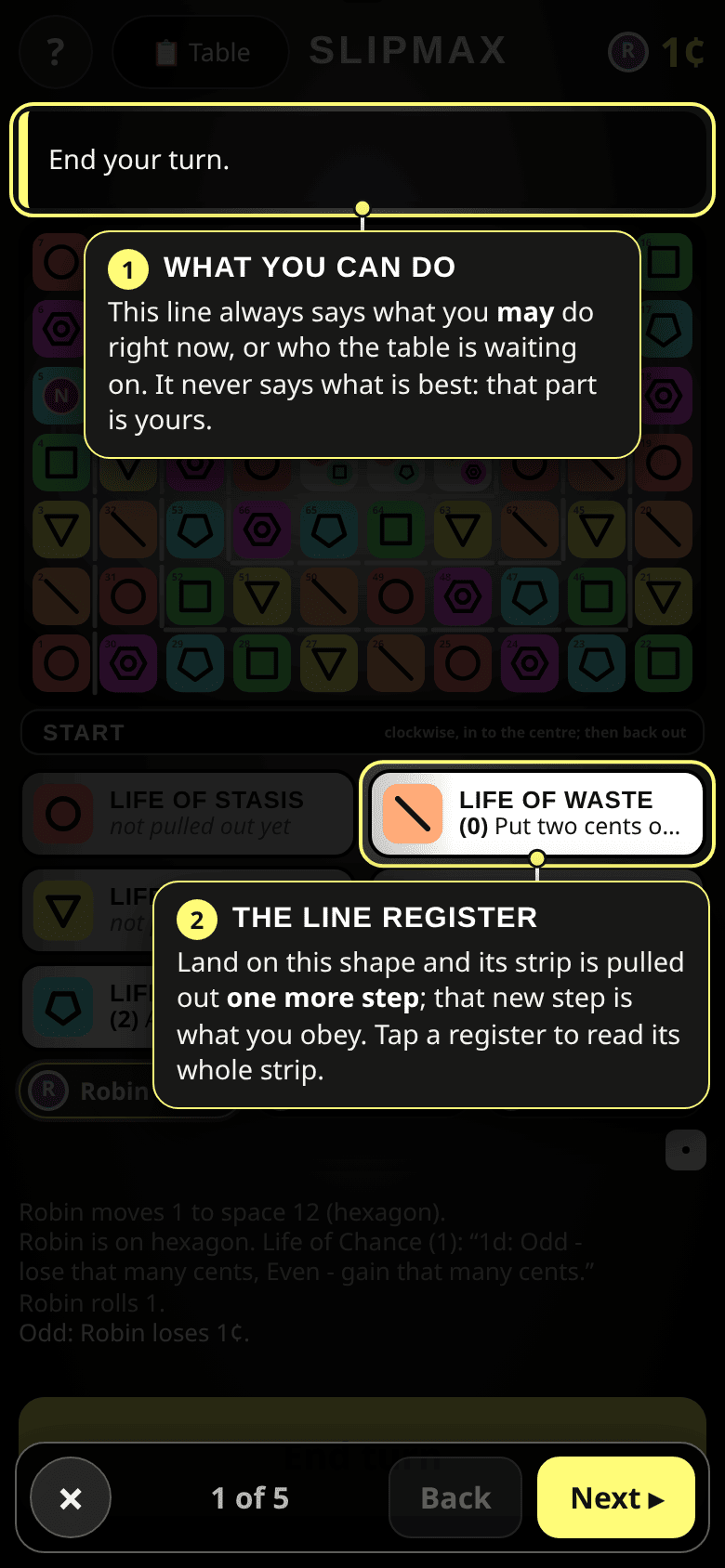
- Every space has one of 6 shapes, and each shape has a register: a window with a strip of numbered rules behind it. At the start only each strip's title shows.
- When you land, the strip for that shape is pulled out one step, and you obey the step that has just appeared. A strip pulled past its last step is used up: a new one from the 20 takes its place, at its first step.
- If other pawns are on the space you land on, you choose: take the step yourself, or apply it to one of them.
- If a step asks for more cents than you have, you pay what you can and move back one space for every cent you still owe.
- Then end your turn. Play passes to the next player.
Locking
- Before you end your turn you may put 2¢ on the register you used. Every 2¢ on a register stops it moving once: the next pawn to land there gets the step that is already showing.
- Landing on a locked register, you choose. Take 2¢ off it (they are yours) and obey the step as it stands. Or pay 3¢ to remove 2¢, as often as you like: once it is empty the strip moves on as usual.
The centre, and the end
- The last 3 spaces have two shapes each. Land on one and you obey both registers, the shape with fewer sides first.
- If your move would carry you past the last space, you collect 3¢ from every player who has not reached the centre yet, then use up the rest of your move heading back out. From then on, forward for you is back along the spiral.
- The game ends when every player has reached one of the 3 centre spaces. Most money wins; equal money shares the win.
Reading a strip
| It says | It means |
|---|---|
| Flip n: [heads]; [tails] | Flip n of your cents. Take the first result for every head and the second for every tail. With fewer than n cents you flip what you have. |
| nd | Roll n dice. |
| nd>x: [win]; [lose] | Roll n dice. More than x: the first result. Otherwise the second. |
| (4) and (6) | Do what steps (4) and (6) of this strip say. "x3" means three times. |
| a coin | One cent. |
| a rule about everyone ("All rolls go backward.") | It is in force for as long as that step is the one showing. The table lists what is in force. |
Good to know
- A strip never changes itself. "Every register" on a strip means every other one.
- Lost turns and extra turns are kept for you: a lost turn is skipped when it comes round, an extra one is taken straight away.
- Life of Fear and Life of Royalty sit on a player. They act when another pawn lands on or passes that player's space.
- Life of Mortallity hands out Time tokens. A player holding 10 is out of the game.
- If a rule leaves the table with nothing that can change (nobody can move, nobody can pay), the game is called after 2 whole rounds like that, and the money is counted where it lies.
- Two variants can be chosen in the lobby. Tidal: an even roll pulls the strip out a step, an odd roll pushes it back one. Cycles: a strip at its last step is not replaced; it gets a nickel and works its way back down, and at its first step the nickel comes off.
- Bots fill empty seats and play by the same rules through the same door: they see what a player sees.
- If your phone sleeps, your seat waits. A bot covers a turn only after five minutes, with a clock on screen first, and one tap takes the seat back.
Slipmax is a print and play game by Jonathan Leistiko, first published in 2003 for the 1,000 Blank White Questions board (a game by Ben Gibbs and Jonathan Leistiko). The rules, the board and all twenty strips are his: invisible-city.com/content/slipmax. This is the same game on screens: the app moves the strips, counts the cents and keeps the turn order.